
NEXTREAT Laboratories performs GLP compliant vapor pressure determination according to OECD 104, EC A.4, OPPTS 830.7950, EPA 712-C-96-043 based on either one of these methods:
- Isoteniscope method (possible temperature range: 25°C to 100°C and vapor pressures above 1kPa)
- Knudsen cell effusion method
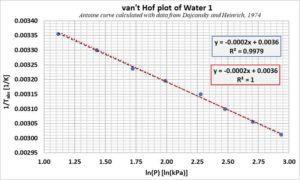
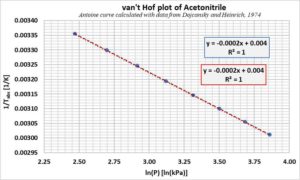
The vapor pressure gives an indication of the probability of the phase transitions liquid/gas and solid/gas. Vapor pressure data might be required for animal as well as environmental studies. In general, the vapor pressure is determined at various temperatures. In a limited temperature range, the logarithm of the vapor pressure of a pure substance is a linear function of the inverse of the thermodynamic temperature according to the simplified Clapeyron-Clausius equation.
For REACH registration purposes, vapor pressure determination does not need to be conducted in the substance has a melting point above 300°C or a boiling point below 30°C. If the melting point between 200°C and 300°C, a limit value or calculation (expert opinion) is normally sufficient.
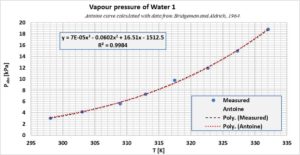
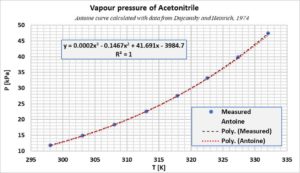
Exemplary result of a vapor pressure measurement by the isoteniscope method, compared to published data for reference substances:
- Applicable guidelines:
- Organisation for Economic Co-operation and Development (OECD), Guidelines for the Testing of Chemicals, Guideline No. 104, “Vapour Pressure”, adopted 23rd March 2006
- European Community (EC), EC No. 761/2009, Part A: Methods for the Determination of Physico-Chemical Properties, Guideline A.4: “Vapour Pressure”, Official Journal of the European Union No. L220, August 24, 2009
- EPA Product Properties Test Guidelines, OPPTS 830.7950 Vapor Pressure
- EPA 712-C-96-043, United States Environmental Protection Agency, August 1996